


As part of the Barbados Prison Service rehabilitative programme inmates are provided with the opportunity to participate in vocational programmes which will aid in the reintegration process into the community.
The delivery of Education Services is provided by the prison in formal education and vocational programmes.
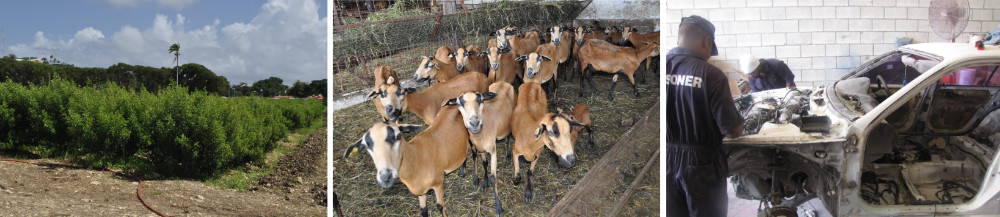
Amenity Agriculture
Agricultural classes are provided to ensure inmates possess the basic skills necessary and the assessment of inmate is done by Technical Vocation and Education Training (TVET).
Construction
Construction classes are provided to supply inmates with the basic skills necessary and the assessment of inmate is done by Walbrent College for accreditation.
Music
Music classes are provided in the area of choir, keyboard and Steel-pan.
Educational
The inmates’ educational needs are done through the baselining tools; such as, Barbados Adult Literacy Assessment (BALA) and other English and Mathematics tests. Inmates are then allocated to the educational services to suit their needs. Educational Services are available in Prison and are provided in partnership with the Ministry of Education; Caribbean Examination Council (CXC), who administered the following: Caribbean Secondary Education Competency (CSEC) Caribbean Certificate of Secondary Level Competency (CCSLC), Second Chance CXC Education Programme, Caribbean Advance Proficiency Examination (CAPA). These programmes are delivered in the various formats; Remedial – Literacy and Basic, Intermediate and Advanced Levels.
Literacy, numeracy and general basic education provision is the priority and broad programmes of education are made available which generally follow a school education approach. Programmes are adapted to take account of the literacy level of the prisoner population and the complex nature of prison life.
The Education Services are provided for all inmates within the prison. In 2013 the Education Department is proud to state that there has been a high pass rate; where thirty (30) inmates passed at the CSEC (27) and CAPE (3) levels.
The following programmes are delivered by the following individuals:
- Peer tutors (Inmates)
- Volunteers (Teachers and/or Past Teacher)
Course and programmes can be broadly categorised as follows:
- Basic Computer Education: Instructing inmates on the basic computering
- Vocational Education: Instructing inmates on construction, music, and amenity agriculture.
- Remedial Education: ability read and write; thus, moving the inmate to the next level: Basic.
- Basic Education – including literacy, numeracy, English as a second language and communications; thus, moving the inmate to the next level: CCSLC.
- CCSLC Education: Inmate above the basic but not up to CSEC Level; thus, moving the inmate to the next level CSEC.
- CESC Education – inmates who are prepare and ready for secondary level examination; thus, moving the inmate to the next level: CAPE.
- General Subjects – English Language (A); Mathematics; Principle of Business; Principles of Accounts; Social Studies and Office Administration
Work and Vocational Training
The Barbados Prison Service places a strong emphasis on the provision of vocational training activities for inmates. Training activities are chosen to give as much employment as possible in prison and to give opportunities to acquire skills which help them reintegrate into society rehabilitated inmates and secure employment on release.
Prison Industries
Inmates are allocated from the assessment of Sentence management and authorized by the Inmate Review Board (IRB). This is disseminated and implemented as the inmates individual Sentence Plan.
A wide range of training workshops operate within the institutions, e.g. Furniture & Cabinet Making, Auto-Body, Auto-Mechanics, Cosmetology, Craft, Leather Craft, Art, Garment Making; (Males & Females), Baking, Barbering, Sanitation (Land Maintenance) Cooking, and Amenity Agriculture (Horticulture, Husbandry, Animal Rearing); and Construction. In addition, workers for essential services for the prisons i.e. building workers, food handlers, laundry services and industrial cleaning are provided through work training.
Excellence
It should be noted that the inmates of the prison have excelled in the areas of Art & Drama. Over the years the prison is renowned for entering and winning the major awards at our Nation Independence Festival Creative Arts (NIFCA).
Retail Sales Outlet
The Retail Sales Outlet supplies to the public and staff the by-products of the prison industries, most notably, art, craft, leather craft and agricultural products. These are supplied at a minimum price with the highest of quality.
- There are 15 workshops & work stations across the prison estate.
- The work and training area has an authorised staffing allocation of approximately 25.
- In excess of 250 prisoners participate in work training activities daily.
- Most of the Courses are externally accredited by TVET other certifying bodies.
- The Work Training Service in partnership with Prison Education delivers interpersonal skills courses.
It should be noted that the skills of the vocational services are provided to governmental and non-governmental agencies. Several prisons support charitable organisations and provide a wide range of services and products to numerous beneficiaries.
Psychology Service
The Psychology Service forms an integral part of the Health Services offered to the inmates at the prison. It provides mental health services to prisoners (coping with imprisonment, depression, anxiety, bereavement, suicide ideations, etc.) and helps offenders address factors that put them at risk of re-offending (anger, substance abuse, sexual and violent offending etc.).
At present there is one (1) psychologist working in prisons – nonetheless, the Psychiatric Hospital personnel provide additional support with their visits to the prison.

